


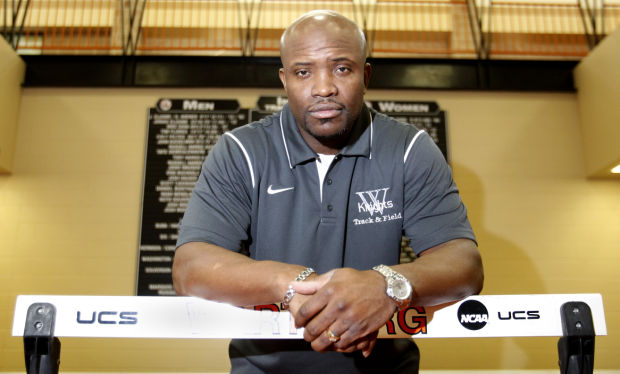
WAVERLY | The town of Lindsborg was like another planet to Marcus Newsom.
A young African-American male from a crime-plagued Kansas City neighborhood had arrived in the small Kansas community to play football and run track at Bethany College. Known as "Little Sweden," 95 percent of Lindsborg's few thousand residents were white.
"I remember telling my coach I didn't feel safe … because I hadn't heard a siren or seen a police car in two weeks," Newsom recalled. "Kids didn't lock their doors and they left keys in their car ignition. People you walked past on campus looked you in the eye and said hello.
"I wasn't used to that," he added. "I never knew what life was like outside the city until I left the city."
More than two decades later, Newsom, 44, is in his 15th year as the head men's and women's track and field coach at Wartburg College in Waverly, an Iowa town not so demographically different from Lindsborg.
People are also reading…
While his teams racked up Iowa Conference and Division III national championships, Newsom has drawn on his life experiences, faith and extraordinary guidance of his mother to help his athletes become successful and adjust to what for many can be very unfamiliar surroundings.
"Being an inner-city kid and going to western Kansas to go to school is no different than being an inner-city kid and coming to Waverly, Iowa," Newsom said. "It presents an opportunity and experience for them that they otherwise wouldn't have."
Miradieu Joseph, a 2001 NCAA Division III national champion for Wartburg in the 400-meter hurdles, was born in Haiti and raised in Lake Worth, Fla., a diverse city near Miami, before joining Newsom's team.
"It was a culture shock," Joseph said. "It was an adjustment coming from a bigger city with more diversity to an all-white campus. It was really nice to have somebody who looks like you and who understood what you were experiencing who you could talk to."
Newsom was not only a phenomenal coach, Joseph said, he was a "mentor, therapist, father figure and enforcer."
"I don't think a lot of people understand his passion for what he does," he said. "The ones who follow him not only become successful on the track and in the classroom, but they also become successful in life."
Newsom attributes his success to his mother, Dottie, a single parent who provided a foundation for Marcus and his sister despite the dangerous and impoverished conditions outside the family's home.
"My mother used to tell us life is more than what you see outside those doors; you've got to be able to see and dream beyond what you see," Newsom said. "She stressed not to put limits on ourselves and she stressed not to make excuses for why you can't be successful."
Books, both about religion and history, were on the shelves. His mother worked long hours to keep Marcus and his sister in Catholic schools.
Newsom's grandmother was active in the civil rights movement. His father, a Vietnam veteran and member of the Black Panther Party, helped start a program that provided breakfast for inner-city kids but left when Marcus was 3 years old.
"My mother would never allow me to speak negative about my dad; she said, 'You will never judge,'" Newsom said. "The struggle for him was he was trying to do all those things and yet neglected he had two kids in his life that he kind of left."
When he wasn't in school or church, Newsom spent his time at the Boys and Girls Club learning "discipline, structure, what it was to be committed" and getting a foundation in sports that eventually led him to a collegiate football and track career.
At Bethany College, he met Richard Torgerson, who was acting president there.
"He and his wife really took an interest in my," Newsom said. "He was like a father figure to me."
Torgerson would later serve in the Wartburg administration before becoming the president of Luther College, in Decorah, a position from which he retired last summer. It was Torgerson who encouraged Newsom to apply for a job in admissions at Wartburg.
Newsom was the diversity recruitment director at Wartburg before becoming the head track coach and associate athletic director. It allowed him to help other kids from inner cities realize their academic dreams.
"One of the things my mother told me was 'I don't care where God places your feet. I do care that you have an opportunity to give back to your community,'" Newsom said. "What she meant was any community where you can give a kid an opportunity to get education, that's giving back. I really feel like after 20 years I've been able to do that."
Missy Buttry Rock, who participated in cross country and track at Wartburg, was one of the most decorated Division III student-athletes, winning 14 national championships. The Shenandoah native now lives in Minnesota's Twin Cities area.
Buttry Rock said Newsom's care for his athletes was genuine.
"Coach Newsom played such a big role in all of my success," she said. "When he knew I was struggling with anything in my life he would take the time to listen to me and encourage me."
She recalled being really down at one point as an injury was threatening to keep her from participating in the national track meet.
"He gave me this book, a blue book, that his mom made for him," she said. "It was full of stuff that reminds you about what's really important in life."
Years after her Wartburg career ended, Buttry Rock's brother, Brandon Buttry, was killed in November 2012 while serving in the U.S. Army in Afghanistan.
"Coach Newsom drove 4 1/2 hours to come to the funeral," she said. "I think that really shows he cares about his athletes more as people."
Under Newsom, the Wartburg women have won 29 consecutive conference track championships since 1999 and seven national championships. The men have won 16 conference titles.
But Newsom isn't just measuring success with a trophies or a stopwatch.
"My first job is to make sure I'm being the right mentor to these young people," he said. "It's not just about winning championships."


