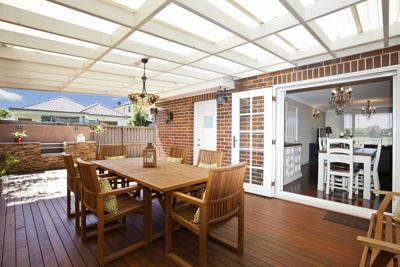


Photo provided by DepositPhotos
Most American homeowners are losing money on space they already own. According to the Industry Council for the Furniture Advancement's 2025 Outdoor Living Trend Report, 85% of U.S. households have outdoor space available, but only 23% of consumers say they use it as much as they want to. The other 77% are underutilizing one of the most expensive square footage categories in their home.
The financial gap gets clearer when you stack that figure against new construction costs. U.S. Census Bureau data from 2024 puts the national median price per square foot for new homes at $154.70, climbing to $220.95 in the Northeast and $195.38 in the West. By that math, a 200-square-foot patio sitting idle represents roughly $30,000 in unused real estate in the average market, and closer to $44,000 in the Northeast.
The reasons trace back to two forces: weather that's becoming harder to plan around, and patios built without the infrastructure to handle it.
People are also reading…
27 Billion-Dollar Weather Disasters Reshape When Americans Use Their Yards
The National Oceanic and Atmospheric Administration's National Centers for Environmental Information confirmed that 2024 brought 27 separate billion-dollar weather and climate disasters across the United States, totaling $182.7 billion in damages. That marks the second-highest annual disaster count in the 45-year record. The same report noted record-warm temperatures across most of the contiguous U.S.
For homeowners, that means fewer comfortable days outdoors. Backyards that once worked from May through September are now interrupted by extreme heat and unpredictable storms. The patio furniture stays. The people don't.
Shade Coverage Cuts Summer Electricity Bills by Up to 14%
Research from Auburn University, published in the journal Ecological Economics, found that dense shade covering roughly 19.3% of a home's exterior reduces summer electricity consumption by 9.3%, or about $21.22 per month. When shade coverage increases to 50%, electricity use drops by more than 14%.
Unlike landscaping, which can take years to mature into functional shade, architectural shade structures deliver the benefit immediately. This is where permanent solutions like aluminum pergolas separate themselves from retractable awnings and fabric canopies. A custom pergola from companies like The Luxury Pergola offers a fixed structure with built-in climate control, which holds up against the same weather events that shorten patio season in the first place.
New Patios Return 95% of Their Cost at Resale, Industry Data Shows
According to a 2025 outdoor living trends report from This Old House, synthesizing data from the National Association of Realtors, Houzz, Brown Jordan, NKBA, and Grand View Research, landscaping upgrades deliver roughly 100% cost recovery. New patios average $10,500 in cost with 95% recovery at resale.
The same report found that 63% of homeowners would prioritize outdoor living if they were remodeling today. That signals a real shift in how Americans rank home improvements, and the market is catching up to what the underutilization data already shows.
Aluminum Systems Are Outperforming Retractable Awnings and Fabric Shades
Retractable awnings and fabric shades remain popular for their lower upfront cost, but they require ongoing maintenance, often fail in high winds, and rarely add appraised value. Permanent aluminum systems behave more like part of the house than an accessory.
For homeowners losing five months of patio use to heat and weather, the cost of inaction is real. If a covered structure reclaims even half of those idle months, the return shows up in utility bills and at resale.
Outdoor Living Is Emerging as the Next Major Home Investment Category
The pandemic changed how people relate to their homes, and the data suggests outdoor space is where the next round of investment is heading. With climate disruption reshaping when and how people spend time outside, the question is no longer whether to invest in outdoor living, but whether to invest in something built to last.
Covered outdoor living isn't a luxury upgrade in the traditional sense. It's a math problem about wasted square footage. As more homeowners run the numbers, the patio is starting to look less like a seasonal amenity and more like the most under-leveraged room in the house.